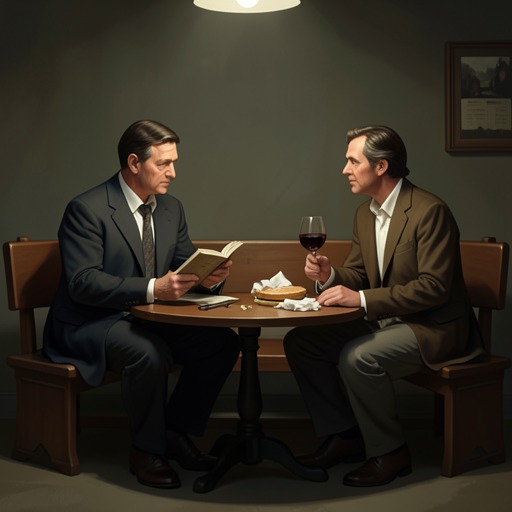
Maggie and Marco’s first kiss at the wedding
Never Kiss a Man in a Christmas JumperMaggie and Marco’s first kiss at the wedding is the moment their guarded intimacy becomes an unmistakably mutual romantic relationship. The turn begins with a dance rather than a declaration: Marco, injured and using a crutch, invites Maggie onto the floor, and she lets him hold her. Their first kiss makes visible what their shared closeness has already stirred in them, while leaving its meaning briefly difficult for either to name.
Circumstances and Invitation
As the evening slows, Maggie is already aware of the approaching separation. She imagines Marco returning to his life thousands of miles away and herself trying to resume hers, and recognizes that caring for him has offered a glimpse of a different kind of ordinary life. But when Last Christmas plays, she decides this is not the moment to rehearse the loss. The scene therefore places the kiss between anticipation of an ending and a deliberate pause in that anticipation: for now, she will enjoy being with him.
Marco asks her to dance to a slow song, making light of his limitations and offering his hand. Maggie refuses at first. She sees the practical risks plainly: Marco has a broken leg, has been drinking, and she does not dance. More privately, she knows that touching him outside the context of medical care would invite a closeness she has been resisting. Her refusal is not indifference; it is an attempt to keep desire within limits she can manage.
When The Power of Love begins, Marco insists that this is the song for them and imagines it becoming a memory Maggie can laugh about after he has gone. He tries to make the invitation easier by joking that he has practiced hopping on one leg and is not drunk. Maggie remains wary, but eventually takes his hand. Her first concession is carefully practical: she guides them to the edge of the floor, near a wall, so he will have support if one crutch and her are not enough. Caution shapes the beginning of the dance even as she agrees to it.
The Dance and the Kiss
As the song rises, Maggie recognizes it as one of her own favorites. She allows Marco to draw her close, his arm around her waist, and rests her head against his chest. The scene dwells on bodily feeling rather than explanation: the pressure of his hand at her back, their heartbeats, their slight movement to the music, and the touch of his lips against her forehead. The dance brings her physical awareness of him to the foreground before she can settle what that awareness means.
With the lights dimmed, Maggie gives in to the closeness. She closes her eyes and imagines that they are alone, though the room remains full of people. Marco’s kiss begins with a pause that leaves her room to refuse. She does not pull away. Her ragged breath and trembling hands answer him, and the kiss deepens; they stop dancing and remain absorbed in each other until they have to break apart for breath. The change is both small and decisive: a shared dance that could still have been remembered as play becomes a kiss accepted by both of them.
Immediate Meaning and Uncertainty
Afterward, the two remain in each other’s arms, looking at one another while the other couples continue around them. Maggie’s first response is to ask what has just happened. Marco cannot fully explain it either, and offers the song as a possible cause. Their uncertainty does not cancel the clarity of their actions. The kiss is not presented as a planned confession or a settled agreement about the future; it is a physical acknowledgment of an attraction they have both allowed to become real.
For Maggie, that acknowledgment cuts across the guardedness she has worn like a cloak. She has been afraid of what Marco’s departure will mean and has treated ordinary, non-medical touch as a risk. Yet the dance makes her experience the possibility of intimacy directly, before she can reason it away. The wedding setting gives the encounter a public social frame, but the decisive exchange is private in its attention: the offered hand, her acceptance, his pause, and her answer through touch.
Later Echoes and Significance
The kiss does not by itself resolve the question of whether they can build a life together. Maggie’s fears about separation and the future remain part of their relationship. Later, however, Marco’s actions answer the dance’s tentative promise with a more explicit appeal. He gives her a first edition of Maggie’s Mabel Lucie Attwell-illustrated Alice in Wonderland, replacing the treasured book ruined when their bicycles collided. The replacement shows that he remembered both the object and what Maggie had told him about it: it had been a gift for Ellen, but also a book bound up with Maggie’s own childhood and her mother.
When Maggie says she has no gift for him, Marco asks instead for a chance at a shared future. He tells her that he wants a real future with her, not an imagined perfect life with someone else. The book makes that appeal concrete: an earlier accident damaged something precious, and he has listened closely enough to find an exact replacement. Maggie calls it perfect and kisses him, then agrees to give the relationship a chance. In retrospect, the first kiss at the wedding is the earlier crossing of the same threshold. It does not promise certainty; it establishes that the desire, and the willingness to answer it, belong to both of them.